By Kelly Keene
To a Star Seen at Twilight by John Rollin Ridge is a poem about inspiration. The speaker, a solitary observer, pauses to look at the first star to appear as night begins to fall. Twilight, the last vestige of light before the total dark, blocks out all stars except for the brightest and boldest. Rollin Ridge voices their appreciation for a star that heralds the night, because it is mighty, but also because it stands alone.
The poem begins with enthusiastic praise for the star. “Hail solitary star!” it begins. It is because the star is alone that it first captures the speaker’s appreciation. Despite its glory, the star is “not proud like man,” and this is the moment we realise the star is a metaphor for what humans should strive to be like. In the darkness, and against great odds, people who shine when nobody else does are the ones we remember. These are the people who do the work that lasts throughout time, and who earn an “eternal wreath.”
Most humans want to be remembered. We want to be timeless. In this desire, we sometimes care too much about pleasing others. We sacrifice ourselves to fit in and be popular. That, however, would be like blending into daylight, and becoming invisible. Rollins Ridge uses personification to compare humans to the star in lines 18-22. He says, “I love to gaze upon/ Thy speaking face, they calm, fair brow,/ And feel my spirit dark/And deep grow bright and pure as thou.” He is moved from his darker spirit to shine bright. This comparison serves to show us the benefits of following the star’s example. We are complex, but everyone has potential to shine. Let’s not dim our light.
By the end of the poem, the author repeats “alone” and “companionless” to show that it’s not just the guiding star, that sets a bright example of solitude. “All that are mighty are alone, “ he says in line 40. He goes on to give the examples of mountains, oceans and comets that also inspire him because they stand out and don’t conform. This natural imagery, further contradicts that social pressure to keep up or fit in. If we feel powerful in solitude, that is an organic sentiment to “hail” and celebrate.
Our stargazer shows enthusiasm as they shout to the heavens in the final line.“‘Tis great! ‘Tis great to be alone!” Appreciating individuals not for their popularity, but for their courage, is crucial now more than ever in our less-natural, digital age. Our stars at twilight don’t get the most likes or followers, but their work can last, guide us like the North Star, and inspire.

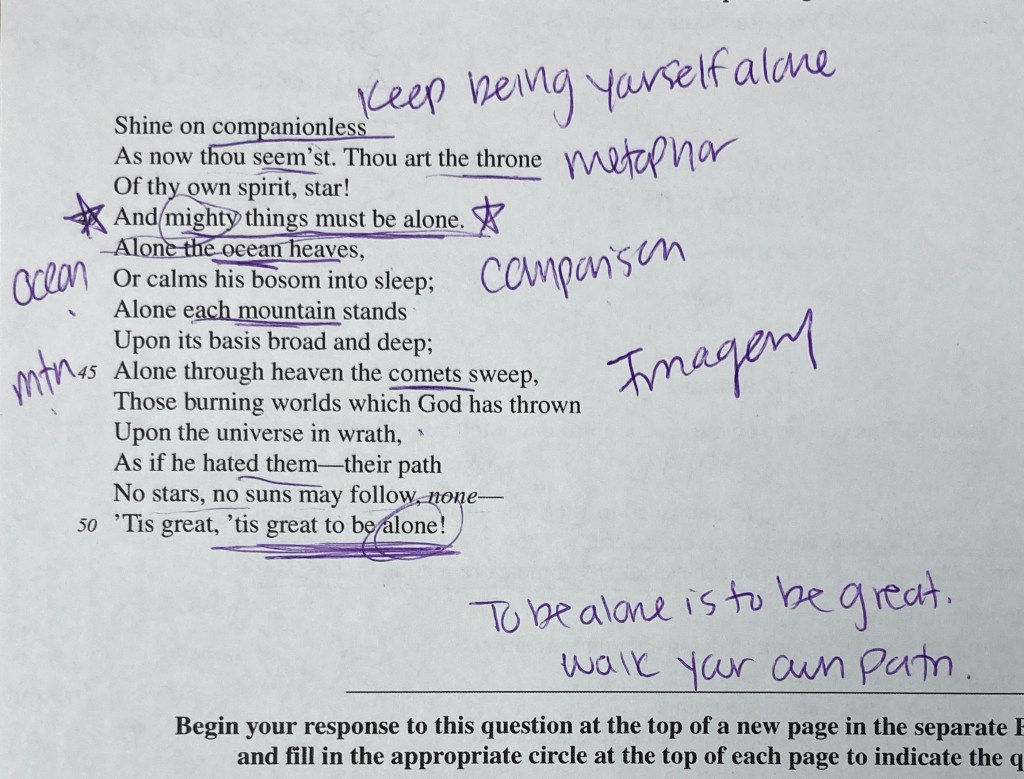
This essay was written after reading and annotating To a Star Seen at Twilight by John Rollin Ridge. The materials were found on AP Classroom. This was the one of the Poetry Essay prompts that appeared on the AP English Literature and Composition Exam in 2024.
 Kelly Keene