by Kelly Keene
The one certainty we know in life is that at some point, it ends. This is a scary thought for many. Even billionaires, with all the wealth and power they possess, cannot thwart death itself. Emily Dickinson, in her poem Because I Could Not Stop For Death paints an image of Death greeting her, like a civil escort that shepherds us from the land of the living. She is comfortable with Death, and does not paint it as something to fear, or hide from.
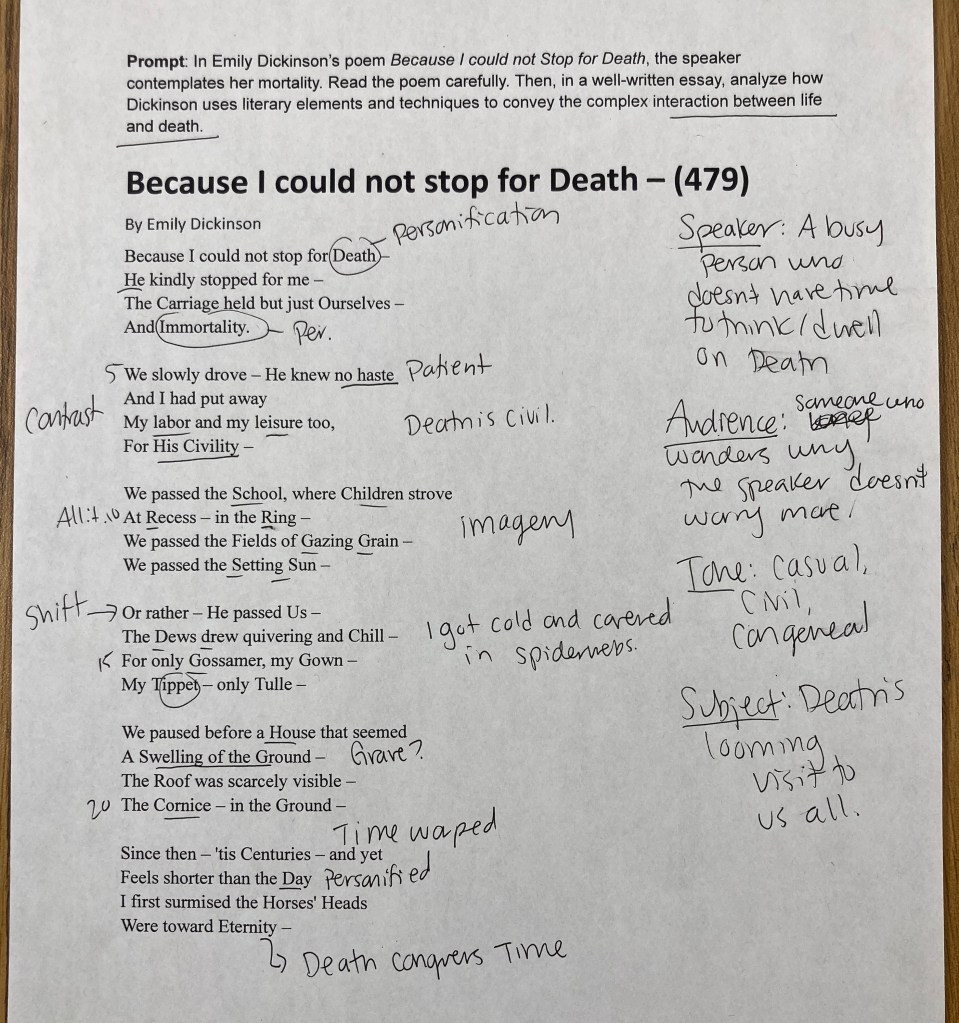
Her syntax in this poem begins mid thought, like an interruption, and ends almost every stanza with a dash- dashing off to the next part of her journey through life. Time feeds this interaction between the speaker and Death because it is the lack of time that motivates the speaker to not worry about Death until it arrives. “Because I could not stop for Death-” she says, “He kindly stopped for me-” (1-2). She characterizes Death as “kind” here to make the ordeal more like a meeting rather than a shock. Even the way Death moves in the poem is gentle. She describes his “carriage” in line three, and how he “slowly drove” in line five. Death is civil, and orderly. Compartmentalizing it this way, helps someone rationalize the fear of death and approach it (or “him”), with a level head.
Three of the next four stanzas begin with “we,” showing that Death is a partner, a companion, and not necessarily an advisory. Stanza three focuses on the beauty of life as they drive by schools, fields, and the setting sun. This imagery, coupled with Dickinson’s alliteration here makes the moment almost nostalgic and peaceful. We think of open fields, children “at recess” and “gazing grain” (10-11). This peaceful scene serves as a juxtaposition between the beauty of life and the “quivering chill” Death brings with it. These images might even be sweeter because they are fleeting, like childhood, or the setting sun. In stanza four, we see the powerlessness of this relationship with time. The speaker clarifies that the sun “passed Us-” (13). Time and death make life valuable. There is a recognition that yes, Death takes the warmth of a “gown” or “tippet” and turns it to “gossamer”, or “tulle” (15-16). These are finer, thin, materials that offer no warmth. That is Death’s power. We feel the absence of warmth more acutely because we know it will someday fade. The speaker isn’t happy or eager to meet Death, but acknowledges it all the same.
Dickinson also compares Death’s arrival as a move from one home to the next. Our new “house” becomes the “swelling ground” (17-18). This is jarring. For someone who is so busy living, that they do not even have time to consider their own demise, they do have time to visualize their final resting place. These images are cold, and shows someone the chill of fixating on what happens when Death comes calling. Is this image we want to waste our precious living time on? Dickinson says no. It might feel like “centuries” are “shorter than the Day” (21-22), but by the end of the poem, Dickinson personifies not only Death, but Time as well. Death’s power comes from its relationship with “Eternity” (24). It’s timeless, so let’s not waste what time we do have before Death arrives considering it much further.
 Kelly Keene