Written by Kelly Keene
Public scorn and ridicule can be brutal. Subtle microaggressions might also feel like daggers if you don’t fit in, or are a part of a marginalized group. When we marginalize people, sometimes they adapt by pretending to fit in. Sometimes, that is easier than standing up to the violence of prejudice. In Paul Laurence Dunbar’s We Wear the Mask, Dunbar adopts the voice of someone who explains, to their peers, why they wear the mask, and what they protect themselves from. Discrimination might be insidious, but the mask is one sly way to counteract it.
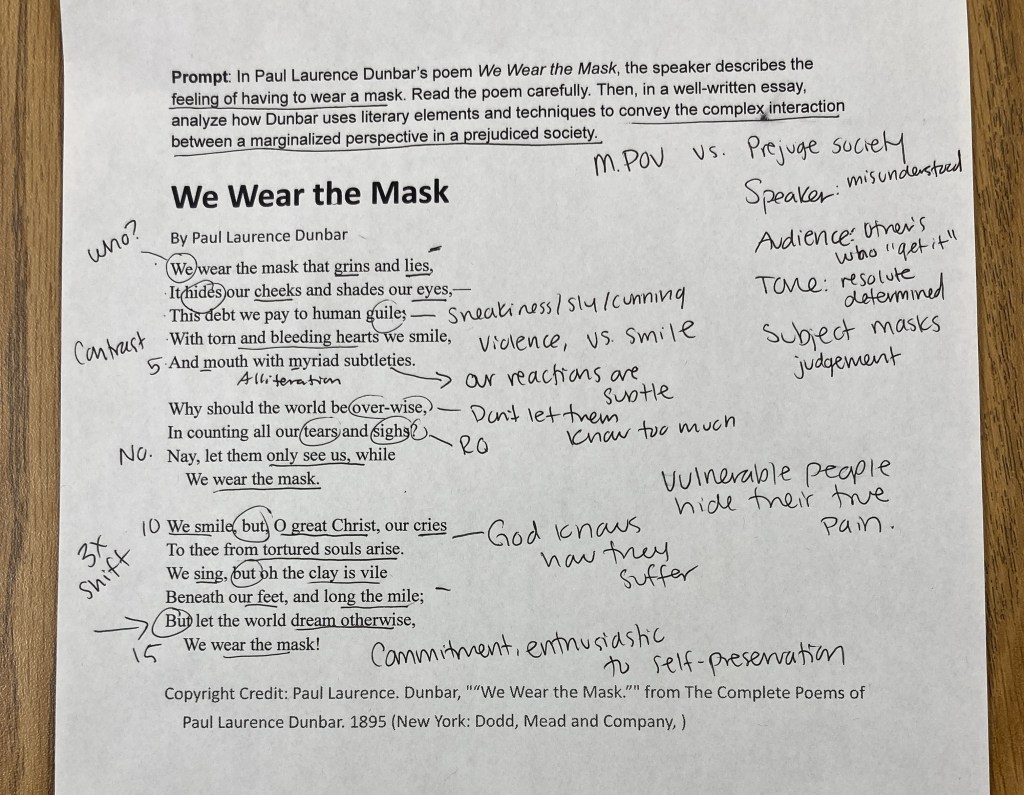
Deception is where Dunbar starts. He explains that the mask is, in essence, false. It “grins and lies” and “hides our cheeks and shades our eyes” (1-2). It’s a symbol for how people mask their emotions and pretend that they are fine, when really, they are unhappy. Lying might not be a virtue he wants to preach, but it’s justified because of the violence of their “torn and bleeding hearts” (4). The act of pretending is an act of self preservation. It’s not easy to grimace through the pain, but in doing so, marginalized people have a “myriad of subtleties” they can use to combat the prejudice they face. The rhyme scheme and rhythm of this poem mirrors this intention. It has a sing-song feel with rhyming couplets like “guile” and “smile,” but breaks the pattern at the end of each stanza (3-4). The truth is not as simple, or easy as it seems.
In the middle stanza, the speaker asks a rhetorical question. It’s his way of addressing the counterclaim that it might be better to take the mask off, be vulnerable and let the world know how they really feel. Today, people tout vulnerability as a strength. But Dunbar shows that boundaries can protect us too. “Why should the world be over-wise” to the pain of those who feel cast out (6)? He takes a stand instead, and says, “Nay, let them only see us, while/ we wear the mask” (8-9). This is a resolute decision. Those who participate in prejudice do not deserve the vulnerability of those they harm.
In the last stanza, Dunbar moves back and forth between the image our speaker wants to project outwardly, and how they really feel under the mask. Although they “smile,” a “christ” or God-like figure knows how they really feel (10). They are truly “tortured souls” (11). Despite an outward projection of joy, or hope that comes from the “singing” we see in line 12, their path is difficult, long and arduous. But the speaker recommits to their boundaries at the end. They want to carry on pretending, and letting “the world dream otherwise” (14). They want to keep wearing the mask.
Despite the frustration we feel in this piece, it reads, overall, like a battle cry. Nobody should be made to feel like they need a mask to protect themselves. If we are genuine, kind, and accepting, we don’t need to pretend. However, that is not the feeling our speaker shares. Dunbar argues that when trust is broken, and some are cast aside, their only way to fight this oppression, might be to mask up, and keep their true selves secret from those that have caused them harm.
 Kelly Keene